


Perhaps a few days after the middle of your cycle, you notice a shift. Your jeans feel a little tighter, your breasts are tender, and you might crave something salty or sweet. A cycle-tracking app tells you you’re “in your luteal phase.” But what does that actually mean?
In this article
The luteal phase is the part of an ovulatory cycle after ovulation and before your next period. Its star is progesterone, a hormone that gets your body ready for a possible pregnancy. Understanding this phase can make many changes before your period feel a lot less mysterious.
Where the luteal phase fits in your cycle
Your ovarian cycle has two main phases. During the follicular phase, an egg develops; this phase starts on the first day of your period. Ovulation releases the egg, and the luteal phase follows until the next period begins. Ovulation does not have to happen halfway through your cycle.
Cleveland Clinic describes a typical duration of 12 to 14 days, with variation around that. A 2019 study of more than 600,000 ovulatory cycles found more variation in the follicular phase than the luteal phase. These were app users with estimated ovulation, so the findings describe a selected group rather than a timetable everyone should match.
For the full sequence, see our guide to menstrual cycle hormones.
The corpus luteum: a temporary hormone factory
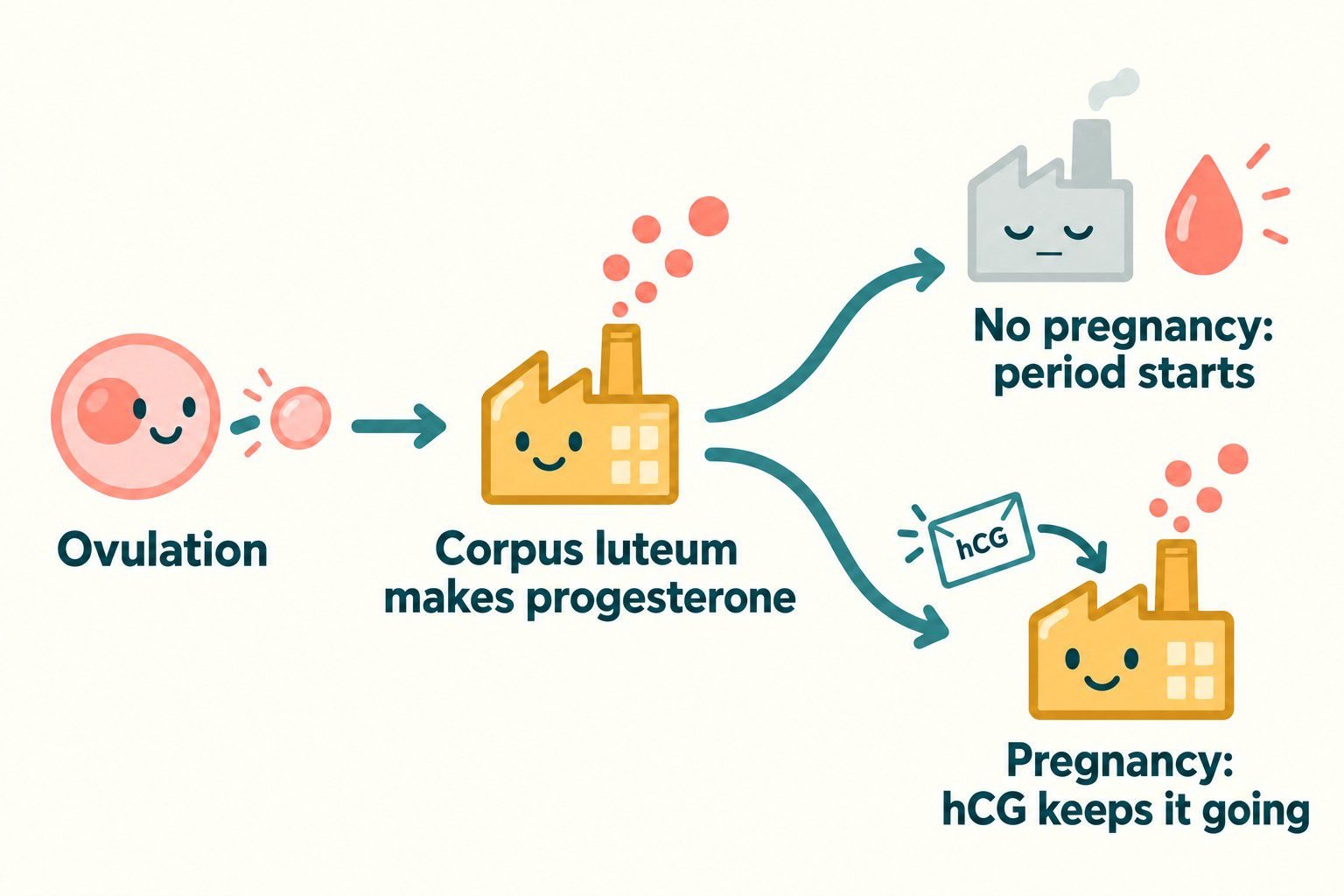
After the egg is released, the follicle it came from changes. It transforms into a small structure called the corpus luteum (Latin for “yellow body”). It works like a pop-up hormone factory, making progesterone and some estrogen. Cleveland Clinic explains this temporary structure and its role in early pregnancy.
What happens next depends on whether pregnancy occurs:
- No pregnancy: The corpus luteum breaks down. Progesterone and estrogen fall, and that drop signals the uterine lining to shed. That’s your period.
- Pregnancy: An implanted embryo sends a signal (the pregnancy hormone hCG) that keeps the corpus luteum going until the placenta can take over hormone production.
What progesterone does in this phase
MedlinePlus explains how progesterone supports the uterine lining after ovulation. Here are changes you may hear about:
- Prepares the uterine lining. After estrogen has helped the lining grow, progesterone helps it become ready for implantation and supports it in early pregnancy.
- Changes cervical mucus. Mucus often becomes thicker and less noticeable than the slippery mucus around ovulation. It varies, so this sign alone cannot confirm ovulation.
- Raises your resting temperature slightly. A small rise after ovulation is what basal body temperature tracking looks for. It is a clue about a change that has already happened, not a reliable prediction of when ovulation will occur.
ACOG explains mucus and temperature patterns and the limits of using them for fertility awareness. Symptoms or a single body sign cannot tell you whether progesterone is “high enough.” Our comparison of estrogen vs. progesterone explains their different roles.
Common luteal phase symptoms
The Office on Women’s Health describes premenstrual symptoms that can occur in this part of the cycle, including:
- Bloating
- Breast tenderness or swelling
- Mood changes or irritability
- Tiredness or sleep changes
- Food cravings or appetite changes
These overlap with premenstrual syndrome (PMS). They can be mild, but some people find them disruptive; many improve soon after bleeding starts. If mood symptoms are severe, read our guide to PMS vs. PMDD.
Everyone’s luteal phase feels a little different. For example, one person might notice nothing except a slight temperature rise, while another feels puffy and tired for a few days every month. Neither experience measures hormone levels. Persistent or disruptive symptoms deserve attention.
What about a “short luteal phase”?
The ASRM committee opinion updated in 2026 discusses luteal phase deficiency, often associated with a phase of about 10 days or less. Definitions and measurement methods vary. A short estimate on an app does not establish a disorder.
ASRM says no diagnostic test reliably identifies luteal phase deficiency, and it has not been proven to independently cause infertility or pregnancy loss. A recurring pattern is worth discussing, especially if you are trying to conceive, but it does not by itself mean you cannot get pregnant. Do not start progesterone or supplements based on a calendar estimate.
What you can do
- Get to know your pattern. Track period dates and symptoms. If you also record mucus, ovulation-test results, or waking temperatures, keep them as observations rather than proof of ovulation or hormone quality.
- Count from ovulation, not from day 1. If you have an estimate of ovulation, record the interval until your next period. Note how you estimated it; uncertainty in that date changes the phase-length estimate.
- Be kind to yourself on harder days. If you know your last few days before a period tend to be tough, you could plan extra rest or support. The OWH also suggests regular activity, adequate sleep, and stress-management steps for PMS; these are not treatments for a presumed hormone deficiency.
- Use apps as a guide, not a verdict. An app label may be an estimate from past cycle dates. Body signs add context, but none of these observations alone confirms that you are no longer fertile.
When to talk to a doctor
- You are trying to conceive and have recurring concerns about ovulation or a consistently short estimated luteal phase
- You have bleeding between periods, repeated spotting, or a marked change in your cycle
- Premenstrual symptoms interfere with everyday life
If pregnancy is possible and your period is late, a home pregnancy test is more useful than guessing from luteal-phase symptoms. The NHS advises testing from the first day of a missed period, or at least 21 days after unprotected sex if you do not know when a period is due. Follow the test instructions; if a repeat test is negative and your period still has not arrived, contact your clinician.
A clinician may time a progesterone blood test to look for evidence of recent ovulation. Levels fluctuate, so one result cannot measure the quality of the whole luteal phase. Ask what question the test is answering and how to time it. Our guide to hormone testing for women helps you prepare.
Frequently asked questions
How long is the luteal phase?
Often about 12 to 14 days, with variation. Your phase does not have to match a fixed 14-day calendar, and an uncertain ovulation date can make an estimate misleading.
Can you get pregnant during the luteal phase?
Pregnancy can result from sex in the days before ovulation or shortly after it, because sperm can survive for several days and the egg survives for about a day. An app calling a day “luteal” does not confirm ovulation has happened or rule out pregnancy risk. If avoiding pregnancy, use a reliable contraceptive method rather than this phase label.
Why am I so hungry before my period?
Appetite changes are a common luteal phase symptom. Hormone shifts may play a role, though the exact reasons are still being studied.
Does progesterone make you tired?
Some people feel more tired in the second half of their cycle. That feeling is not a test for low or high progesterone. Sleep, stress, and other health factors can also affect energy; discuss tiredness that persists or disrupts your life.