



You’ve finally decided to get your hormones checked. Maybe your periods have changed, you’re exhausted, or your skin is acting up. But then come the practical questions. Do you need a doctor’s order? Should you fast? Does the day of your cycle matter? And what do all those numbers in your patient portal actually mean?
In this article
This guide walks you through the whole process, from ordering to reading your report, so you know what to expect and what to ask. Wondering which tests make sense for your situation? Read hormone testing for women or our overview of lab tests worth asking about.
Step 1: How a test gets ordered
In the US, there are two main routes:
- Through a clinician. Your primary care provider, OB-GYN, or another specialist orders the tests based on your symptoms and history. You then have blood drawn at a lab or clinic.
- Direct-to-consumer. Some services let consumers request tests directly, sometimes with a clinician order arranged by the service. Availability and ordering requirements vary by test, service, and location; check what applies before paying.
The FDA explains that direct-to-consumer tests vary in their supporting evidence and should not replace healthcare assessment. ADLM’s archived 2019 statement also discusses interpretation and laboratory-quality concerns. Ask who will review the result and which follow-up is included. Check coverage and price with the service and your insurer rather than assuming the test will be reimbursed.
Whichever route you take, the most useful tests are the ones chosen to answer a specific question.
Step 2: Ask about cost before you go
Costs depend on your insurance, the lab, and why the test is ordered. Before your blood draw, it’s worth asking:
- Is this test covered by my plan, and will I owe a copay or deductible?
- Is the lab in my insurance network?
- Is this billed as a preventive screening or as a diagnostic test? (This can change what you pay.)
- If I’m paying myself, what’s the price for each test?
Step 3: Prepare the right way
Small details can change your results. Follow the instructions for your specific test, and ask if anything is unclear. Common things that matter:
Scroll sideways to see all columns.
| What to check | Why it matters |
|---|---|
| Fasting | A fasting glucose test requires fasting, while some other blood tests do not. A cholesterol test may be fasting or nonfasting. Follow the exact preparation instructions rather than choosing your own fasting window. The CDC explains fasting for cholesterol tests. |
| Cycle day | Reproductive hormones such as FSH, estradiol, and progesterone change across your cycle. Ask which day to test, and write down the first day of your last period. |
| Time of day | Some hormones, such as cortisol and testosterone, follow a daily rhythm, so a morning draw may be requested. |
| Medicines and supplements | Birth control, hormone therapy, thyroid medicine, and others can affect results. Bring a full list. |
| Biotin | High-dose biotin (often in hair, skin, and nail supplements) can interfere with some lab tests. The FDA has warned about biotin interference. Tell your clinician if you take it. |
| Exercise | Hard exercise right before a test can affect some results. |
MedlinePlus lists these and other factors in its guide to understanding lab results.
Step 4: The blood draw
A blood test usually takes just a few minutes. A small amount of blood is taken from a vein in your arm. You might feel a quick sting, and some people get a small bruise. If needles make you anxious or faint, tell the person drawing your blood; you can often lie down. MedlinePlus explains what to expect.
Step 5: Getting your results
Many patient portals now release results as soon as they’re ready, sometimes before your clinician has had a chance to review them. That can be stressful. If a number is flagged, try not to panic. Flags are a prompt for a conversation, not a diagnosis.
Step 6: Reading your lab report
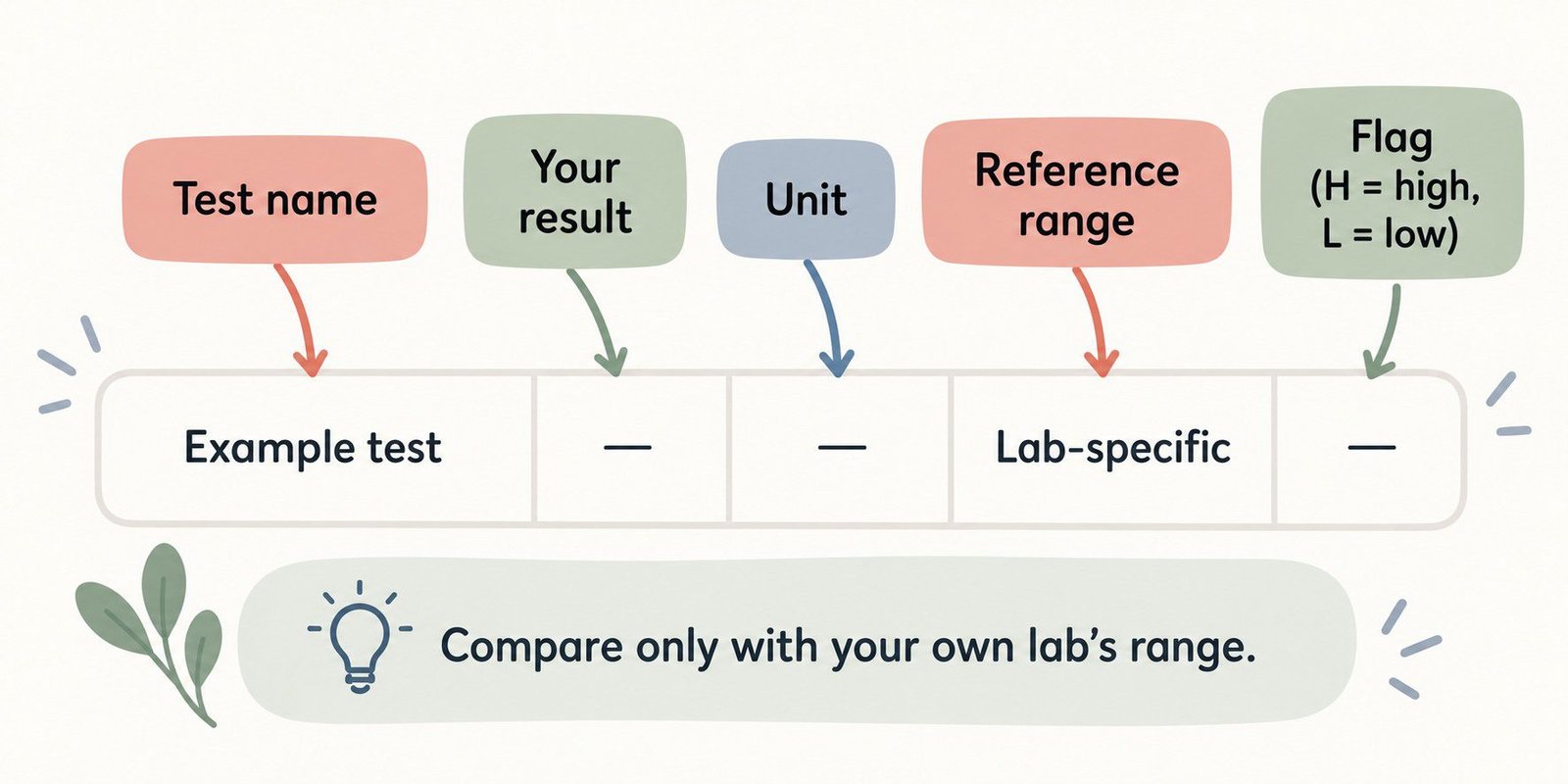
Most lab reports show the same pieces for each test:
- Test name: for example “TSH” or “Estradiol.”
- Your result: the number measured in your sample.
- Units: such as pg/mL or mIU/L. Different labs may use different units.
- Reference range: the range found in a large group of healthy people.
- Flag: “H” or “L” if your result falls outside the range.
Three things to keep in mind, according to MedlinePlus:
- Outside the range isn’t automatically a problem. Healthy people sometimes fall outside it.
- Inside the range doesn’t mean your symptoms aren’t real. You may still need further assessment.
- Compare with your own lab’s range. Labs use different methods. If you’re tracking changes over time, using the same lab helps.
What a hormone blood test can (and can’t) tell you
Scroll sideways to see all columns.
| A test can help | A test can’t |
|---|---|
| Confirm or rule out specific conditions, such as an underactive thyroid | Explain every symptom on its own |
| Show a measurement at one moment in time | Show how a hormone changes from day to day, especially in perimenopause |
| Track a known condition or treatment over time | Give you a “hormone balance” score |
| Help your doctor decide on next steps | Replace your history and symptoms |
For example, in perimenopause, hormone levels can swing so much that one test often doesn’t settle the question. Read perimenopause hormone tests to learn why.
Questions to ask your doctor
Before the test
- What are we trying to find out with this test?
- Would the result change what we do next?
- Do I need to fast, test on a certain cycle day, or come in the morning?
- Should I pause any supplements, such as biotin, beforehand?
- When and how will we go over the results?
After the test
- What does this result mean for me, given my symptoms?
- Is anything outside the range important, or expected?
- Does anything need to be repeated or followed up?
- If the results are normal, what else could explain how I feel?
Do not stop prescribed medicines or pause supplements on your own; ask for instructions for the specific test.
Bringing notes on your symptoms makes this conversation easier. Our free hormone symptom tracker can help.
Frequently asked questions
Can I order my own hormone blood test?
Some services offer consumer-requested testing, but availability, ordering requirements, and insurance coverage vary. Ask about these before paying, and arrange clinical review of the result.
Do I need to fast for a hormone blood test?
Not always. Many hormone tests don’t require fasting, but tests often ordered alongside them, such as glucose or cholesterol, might. Follow your test instructions.
What day of my cycle should I test?
It depends on the hormone and the question. Your clinician or the lab instructions should tell you.
Why is my result “normal” when I feel terrible?
A result within the reference range may make some explanations less likely, but it does not rule out every cause. It’s worth asking what else could be going on.