


You’re at your annual check-up, and your doctor asks if there’s anything you’d like tested. Your mind races: thyroid? Iron? Vitamin D? Hormones? You’ve seen “complete women’s panels” online with 40 tests in them, and you’re not sure what you actually need.
In this article
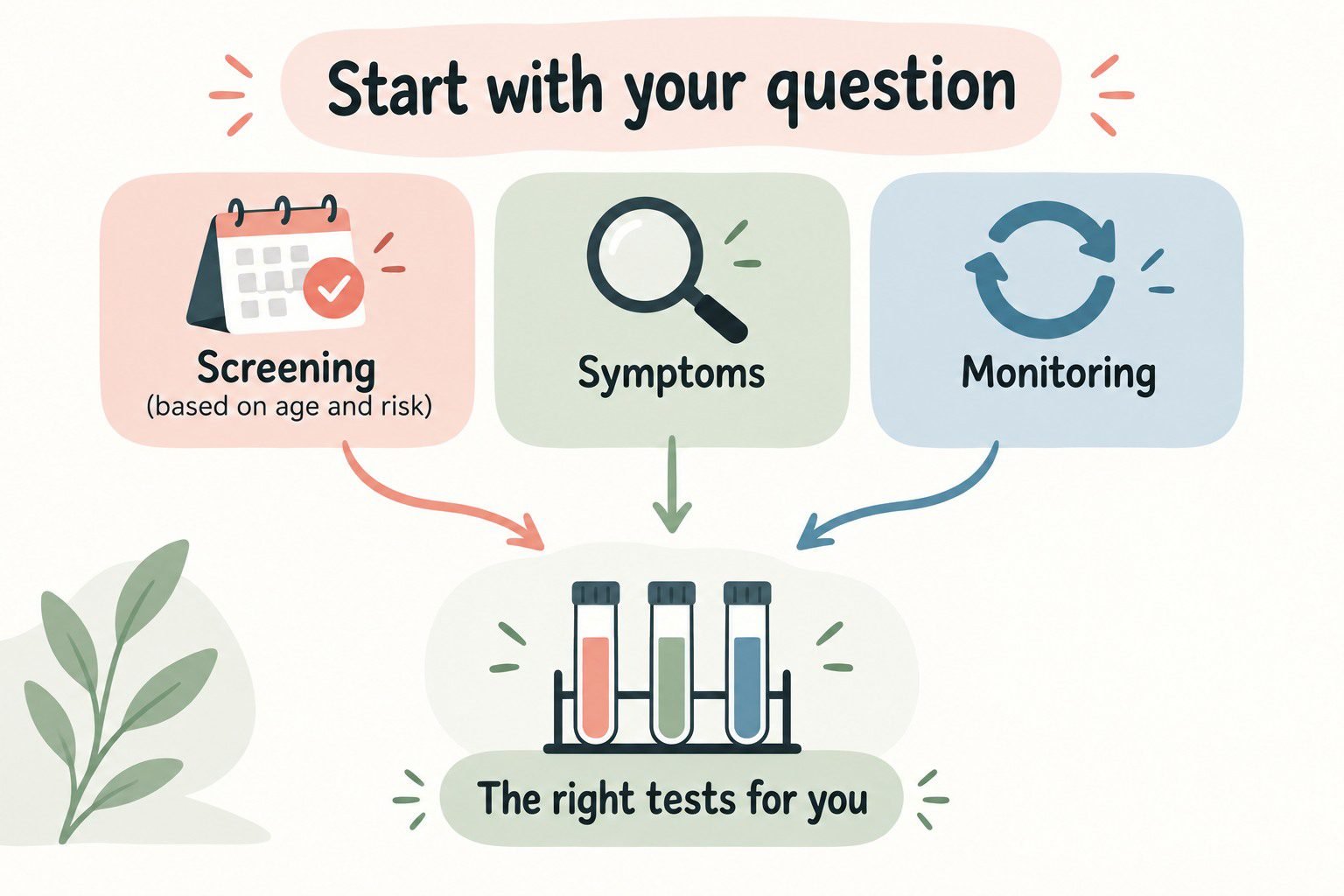
Here’s a helpful way to think about it: the best lab tests are the ones that answer a question about you. That question might come from your symptoms, your age, your health history, or official screening recommendations. This guide walks through common lab tests for women, when doctors tend to consider them, and what to ask, so you can have a focused conversation.
Start with your reason for testing
Lab tests usually fall into three groups:
- Screening tests: recommended for certain groups even without symptoms, such as blood sugar checks for some adults.
- Diagnostic tests: used to look into symptoms, such as tiredness or irregular periods.
- Monitoring tests: used to follow a known condition or a treatment over time.
Knowing which group a test belongs to helps you understand why it’s being suggested, and why another test might not be.
Common lab tests and when they come up
This overview explains when doctors often consider each test. It isn’t a list of tests everyone needs.
Blood sugar: A1C and fasting glucose
What it looks at: your average blood sugar over about three months (A1C) or at one moment after fasting (glucose).
When it comes up: The US Preventive Services Task Force recommends screening for prediabetes and type 2 diabetes in adults aged 35 to 70 with overweight or obesity, according to its screening recommendation for nonpregnant adults without diabetes symptoms. Doctors may also check earlier if you have PCOS (now also called PMOS), a history of diabetes in pregnancy, or a family history. MedlinePlus explains blood glucose tests.
Ask: “Based on my risk, when should my blood sugar be checked?” Read more about insulin resistance and prediabetes.
Cholesterol: lipid panel
What it looks at: LDL, HDL, triglycerides, and total cholesterol.
When it comes up: The CDC says most healthy adults should be checked every four to six years, and more often with heart disease, diabetes, or a family history of high cholesterol. Ask how your age, health history, and previous results affect the interval for you.
Ask: “When was my last lipid panel, and do I need to fast?”
Thyroid: TSH, sometimes with free T4
What it looks at: how your pituitary and thyroid are communicating.
When it comes up: usually to look into symptoms such as fatigue, weight changes, feeling cold or hot, a fast heartbeat, or changes in your periods, or when a person’s pregnancy-related history or risks give a clinician a specific reason to check. For nonpregnant adults without symptoms, the USPSTF found the evidence insufficient to recommend for or against routine screening.
Ask: “Do my symptoms make a thyroid test worthwhile?” Our TSH, T4, and T3 guide explains the results.
Iron and blood count: CBC and ferritin
What it looks at: a complete blood count (CBC) checks red and white blood cells and platelets, including signs of anemia. Ferritin helps assess iron stores, but inflammation and other conditions can affect the result.
When it comes up: with heavy periods, ongoing tiredness, shortness of breath, pregnancy, or a diet low in iron-rich foods.
Ask: “My periods are heavy. Should we check for anemia or low iron?” See always tired? how hormones can play a role.
Vitamin D
What it looks at: the level of vitamin D in your blood.
When it comes up: doctors may test when there’s a specific reason, such as bone health concerns or certain medical conditions. For community-dwelling, nonpregnant adults without symptoms, the USPSTF found the evidence insufficient to recommend for or against routine screening.
Ask: “Is there a reason to test my vitamin D, or would the result change anything?”
Prolactin
What it looks at: a pituitary hormone involved in milk production.
When it comes up: with irregular or missing periods, unexpected milky nipple discharge, or fertility concerns. MedlinePlus explains prolactin testing. Learn more in our pituitary guide.
Ask: “Could prolactin explain my irregular periods?”
Androgens, such as testosterone
What it looks at: androgens, including testosterone, which women also make.
When it comes up: when there are signs like persistent acne, extra facial or body hair, or irregular periods, for example as part of assessing PCOS/PMOS. Read PCOS explained.
Ask: “Do my symptoms point to checking androgens, and which ones?”
Reproductive hormones: FSH, estradiol, progesterone, AMH
What they look at: signals between your brain and ovaries, ovulation, and ovarian reserve.
When they come up: for different specific questions: FSH, estradiol, or progesterone may help investigate cycles or ovulation, while AMH is often used for ovarian-reserve and fertility-treatment planning. A change in periods before 45, especially before 40, deserves assessment, but not everyone needs every test. Cycle timing matters for some reproductive hormones; AMH is less dependent on cycle day. Our guides explain each one: FSH, estrogen and progesterone, AMH, and perimenopause tests.
Ask: “What would this test tell us, and which day of my cycle should I test?”
Pregnancy test
If your period is late or missing and pregnancy is possible, a pregnancy test can be an important first step, including in your 40s. MedlinePlus explains pregnancy tests.
Tests that often add little
Some popular tests are heavily marketed but rarely answer a useful question on their own:
- Large “hormone balance” panels without a clear reason. More numbers can mean more confusion, not more answers.
- Cortisol tests for “adrenal fatigue.” The Endocrine Society doesn’t recognize adrenal fatigue as a diagnosis. See our adrenal gland guide.
- Estrogen or progesterone tests without knowing where you are in your cycle.
- AMH as a fertility score if you’re not seeking fertility care.
What you can do: prepare a focused request
Instead of asking to “test everything,” bring:
- Your main symptoms and when they started
- Your period pattern (dates, flow, changes)
- Your medicines, birth control, and supplements
- Your family history (diabetes, thyroid disease, heart disease, early menopause)
- Results from previous tests, if you have them
A few months of notes from our free hormone symptom tracker can make this much easier. And to know what to expect on the day itself, read hormone blood tests: what to expect.
Questions to ask your doctor
- Which screening tests are recommended for someone my age and with my history?
- Given my symptoms, which tests would help, and which wouldn’t?
- Would any result change what we do next?
- How should I prepare: fasting, timing, supplements?
- If everything comes back normal, what’s our next step?
Frequently asked questions
What blood tests should a woman get every year?
There’s no single yearly list for everyone. Screening depends on your age, risk factors, and history. Ask your doctor which tests apply to you.
Should I ask for a full hormone panel?
Usually it’s more useful to ask for tests that match your symptoms or risk. A large panel without a clear question can lead to confusing results.
Are vitamin D and thyroid tests part of a routine check-up?
Not automatically. For nonpregnant adults without symptoms, the USPSTF found insufficient evidence to recommend for or against routine thyroid screening; its vitamin D recommendation also concerns community-dwelling adults. Your doctor may test when there is a specific reason.
Can lab tests diagnose a “hormone imbalance”?
Lab tests can help diagnose specific conditions, such as thyroid disease or PCOS/PMOS. “Hormone imbalance” on its own isn’t a diagnosis.