


Your period used to show up like clockwork. Now it’s 24 days one month, 40 the next, and you’re checking your calendar wondering what changed. Or maybe you’re 15 and your periods have never followed a pattern at all.
In this article
Here’s the reassuring part: a cycle that changes is often your body responding to something ordinary, like stress, a new birth control method, or a normal life stage. Your dates can help you spot a change, but they cannot tell you which hormone or condition is responsible. When the pattern shifts, it’s worth noticing and asking about.
What counts as an irregular period?
Your menstrual cycle is counted from the first day of one period to the first day of the next. According to the National Institute of Child Health and Human Development (NICHD), a typical adult cycle ranges from 21 to 35 days. NICHD describes these patterns as menstrual irregularities:
- Infrequent periods: more than 35 days apart
- Frequent periods: less than 21 days apart
- Big swings: cycle lengths that vary by more than 20 days
- Long bleeding: bleeding that regularly lasts more than 8 days
- No period for 3 months or more when you’re not pregnant
For teens, the usual range is wider: about 21 to 45 days in the first years after periods begin. ACOG advises evaluation for cycles outside that range or a gap of 90 days, even once. These ranges are a starting point for a conversation, not a diagnosis.
How hormones set the rhythm
Your brain and ovaries communicate through hormones. FSH and LH are signals from the pituitary gland that help an egg develop and be released. After ovulation, the ovary makes more progesterone to support the uterine lining. If pregnancy does not occur, progesterone falls and bleeding begins, as the MedlinePlus explains.
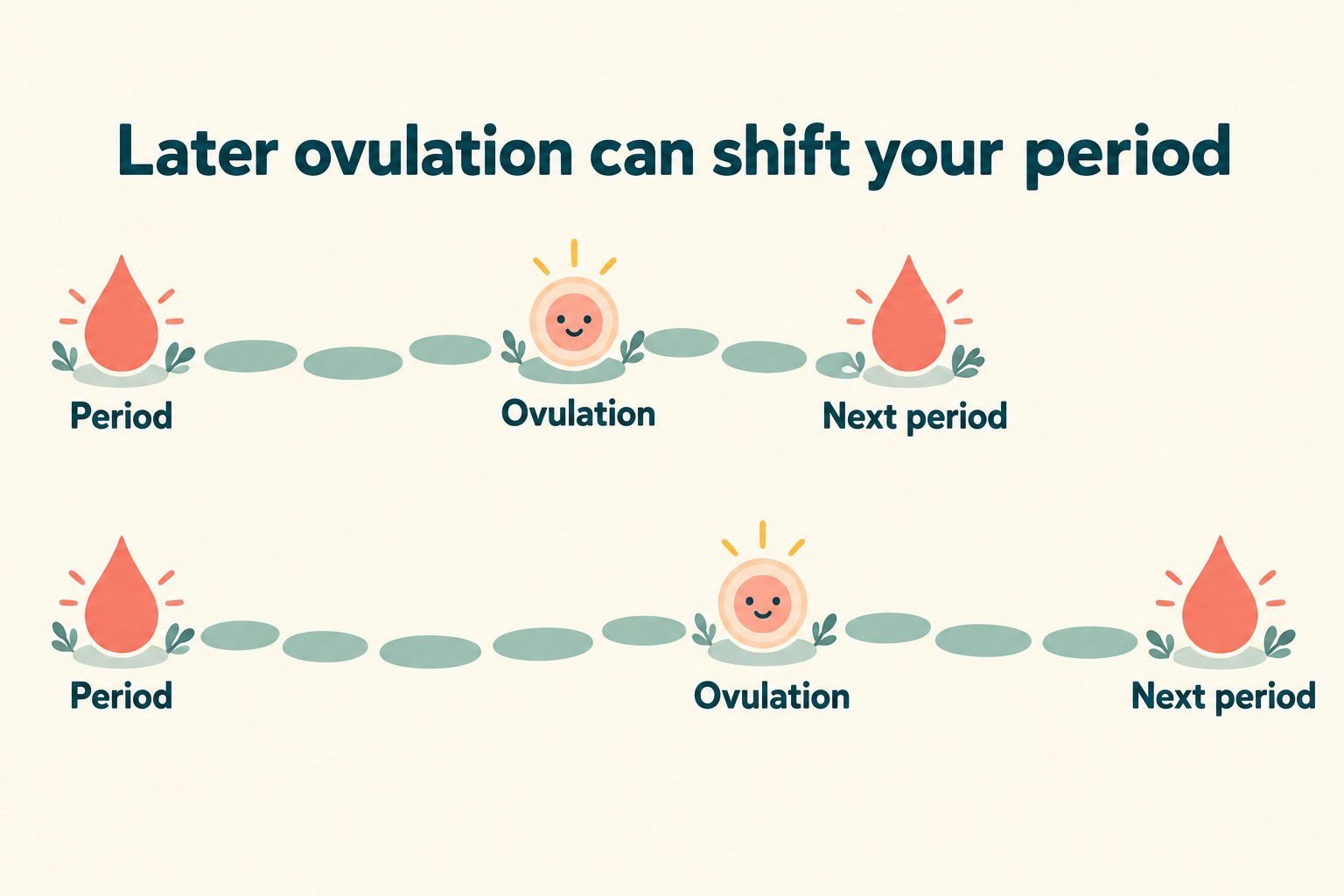
Later ovulation can shift the next period later. If ovulation does not happen, bleeding may be absent or unpredictable. But irregular cycles can also occur when you do ovulate, so calendar dates alone cannot show what happened. Our guide to menstrual cycle hormones walks through each phase.
Common reasons your cycle changes
There’s rarely one hormone to blame. Here are the most common explanations, roughly by life stage.
Life stages
- Puberty: The brain-ovary feedback loop takes a few years to settle.
- Pregnancy and breastfeeding: A missed period can be the first sign of pregnancy. Breastfeeding can also delay periods. Read more about postpartum hormones.
- Perimenopause: In your 40s, ovulation becomes less predictable. Cycles may get shorter at first, then longer, with skipped months. See perimenopause vs. menopause.
Everyday factors
The NHS lists stress and anxiety, significant weight loss or gain, and over-exercising as common causes. Hormonal birth control, including some pills, the shot, and hormonal IUDs, can also change your bleeding pattern. For example, someone whose cycle changes during intense training can bring their training and meal patterns to an appointment rather than assume stress is the explanation.
Medical conditions
NICHD lists several conditions that can affect cycles, including:
- PCOS, now being renamed PMOS, which can involve infrequent ovulation
- Thyroid problems, from too much or too little thyroid hormone (see TSH, T4, and T3 explained)
- High prolactin, a pituitary hormone involved in breastfeeding
- Primary ovarian insufficiency, when ovarian function is reduced before age 40
- Eating disorders and uncontrolled diabetes
- Structural causes such as fibroids or polyps, which tend to cause heavy or prolonged bleeding
- Certain medicines, including some for epilepsy or mental health conditions
What you can do
- Start tracking now. Keep tracking while you arrange care if needed; do not wait months when you have concerning symptoms. Note the first day of each period, how many days you bleed, how heavy it is, and any spotting. Our free hormone symptom tracker makes this easier.
- Add context. Write down big stress, travel, illness, weight changes, new exercise routines, or medication changes. Patterns often make more sense next to your life.
- Take a pregnancy test if there’s any chance you could be pregnant and your period is late.
- Look after the basics. If you have been eating too little for your activity level, discuss food intake and training with your clinician. For a specific condition called functional hypothalamic amenorrhea, restoring energy balance is part of care. This is not a guaranteed fix for every irregular cycle.
- Bring your notes to your appointment. A few months of real dates tells your doctor more than “it’s been weird lately.”
When to talk to a doctor
The NHS advises seeing a doctor if your periods become irregular or your usual pattern changes. Make an appointment soon if:
- You’ve had no period for 3 months and you’re not pregnant
- Your periods last longer than 7 days
- You have bleeding between periods or after sex
- Irregular periods come with extra facial or body hair, acne, weight changes, or unusual tiredness
- You’re trying to get pregnant and your cycles are irregular
- You have any bleeding after menopause, even a small amount or just once
- Your bleeding is heavy. The CDC’s signs of heavy menstrual bleeding include soaking through a pad or tampon every hour for several hours, passing clots the size of a quarter or larger, or feeling tired and short of breath
Seek emergency care if you are changing pads or tampons every hour for more than 2 hours and also have chest pain, shortness of breath, or feel lightheaded or dizzy. ACOG flags this combination as an emergency. Do not wait to reach a time threshold if you are fainting or feel severely unwell.
If pregnancy is possible, bleeding with pelvic pain needs prompt medical advice even without a positive pregnancy test. Sudden intense pain with dizziness or fainting needs emergency care because it can be a sign of a ruptured ectopic pregnancy.
Depending on your history, your clinician may suggest a pregnancy test, thyroid and prolactin tests, other hormone tests, or an ultrasound. The ASRM guidance on absent periods explains why evaluation starts with your history and pregnancy exclusion. Our guide to hormone testing for women helps you prepare questions.
Frequently asked questions
Can stress make your period late?
Yes. Stress can affect cycle timing, but a late period does not prove stress is the cause. If late periods keep happening, or you go 3 months without one, get checked.
Is it normal for periods to be irregular in your 40s?
It’s common. Changing cycle length is often one of the first signs of perimenopause. New heavy bleeding, bleeding between periods, or very frequent periods still deserve a check.
Are irregular periods normal for teenagers?
Some variation is common after periods begin, usually within 21 to 45 days. Ask for a check if cycles fall outside that range, a gap reaches 90 days, or bleeding is heavy or lasts more than 7 days. Talk to a clinician if your first period has not started by age 15 or within 3 years of breast development, as the ACOG guidance above advises.
Can a blood test show why my periods are irregular?
Sometimes. Tests like a pregnancy test, TSH, or prolactin can point to specific causes. But many irregular cycles have normal results, so your history and tracked dates matter just as much.