


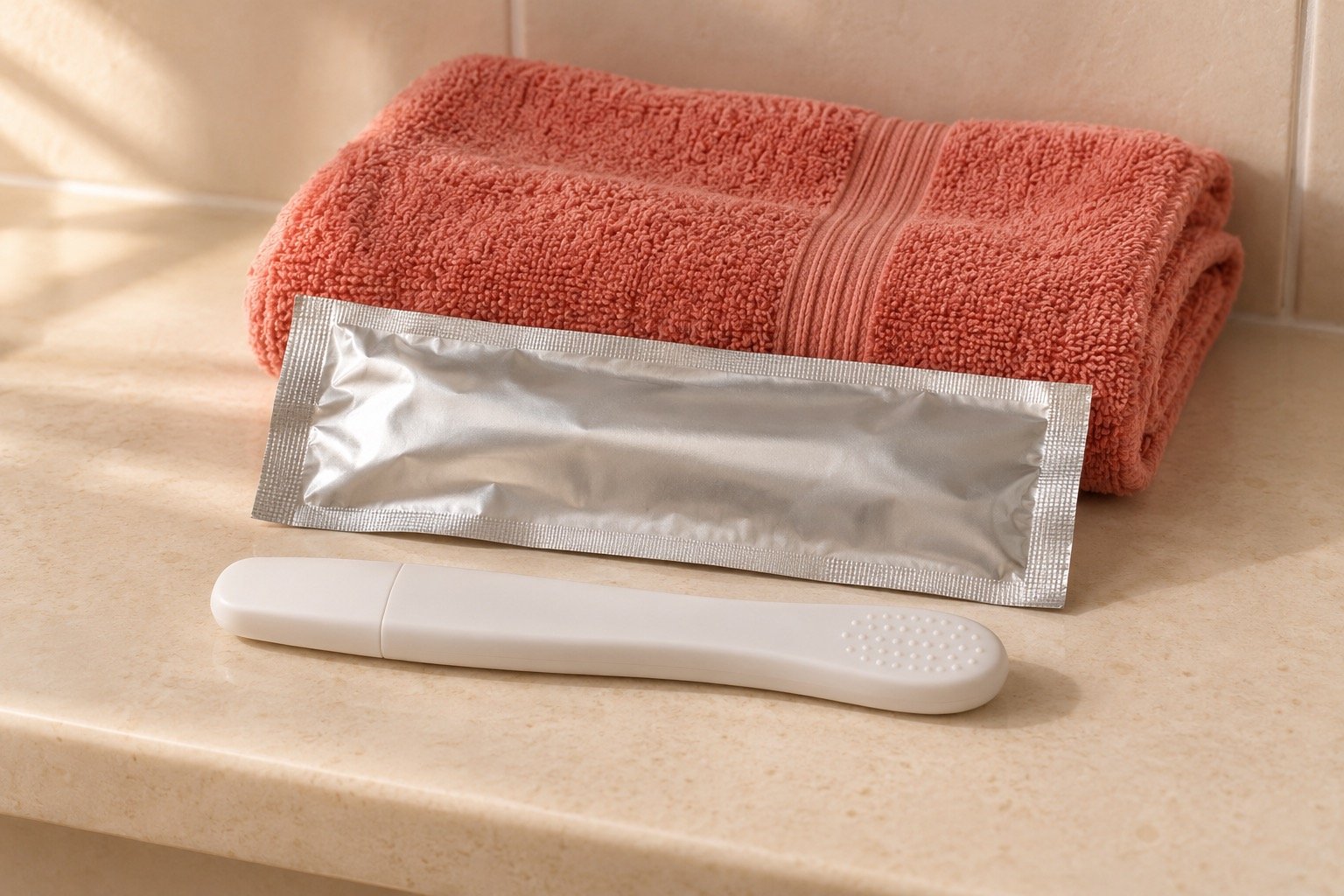
You may meet LH on an ovulation test box, then see the same initials on a blood test order. It is easy to wonder whether both tests answer the same question. Luteinizing hormone (LH) helps coordinate reproduction. A home urine test looks for a rise before ovulation, while a blood test measures LH for a clinical question.
In this article
What does luteinizing hormone do?
Your pituitary gland, near the base of your brain, makes LH. In people who menstruate, LH helps regulate the cycle and its surge triggers ovulation, the release of an egg. LH also signals the testes to make testosterone. It works alongside follicle-stimulating hormone (FSH), another pituitary hormone involved in reproduction. MedlinePlus explains LH’s roles.
For the broader sequence, see our menstrual cycle guide. Our FSH guide explains the companion hormone you may see on your lab order.
Urine LH tests and blood LH tests
Scroll sideways to see all columns.
| Test | Question it can help answer | Context to keep |
|---|---|---|
| Home urine ovulation test | Is an LH surge being detected? | The brand’s instructions and testing dates |
| Laboratory blood LH test | How does LH fit the reason for testing? | Cycle timing, symptoms, medicines, other results, and the lab’s range |
A home kit detects a hormonal signal associated with approaching ovulation. The FDA describes most urine kits as qualitative tests, giving a positive or negative result. Their instructions vary. Follow your kit’s directions for when to begin, sample collection, and reading the result. These kits are unsuitable for preventing pregnancy. Read the FDA’s urine ovulation test guidance.
A blood LH test may help investigate irregular or absent periods or fertility concerns. Your clinician considers LH together with your history and other hormone results, often FSH. MedlinePlus describes the clinical uses.
What a positive ovulation test tells you
A urine LH surge commonly precedes ovulation by about one to two days. It provides indirect evidence, and false-positive or false-negative results can occur. With PCOS, also called PMOS in the updated guidance, a higher baseline LH level can make urine results misleading. A clinician can help choose another way to assess ovulation when needed. ASRM explains ovulation testing and its limits.
For example, someone might record a positive home test on Monday and have blood drawn on Friday. Keep each result with its own date and purpose. A useful appointment question is, “How does this blood result relate to the home test I recorded earlier?”
How to approach a high or low blood result
Start with the reference range printed on your own report. LH changes across the cycle, and levels are generally higher after menopause. A clinician may also consider ovarian or pituitary conditions when a result falls outside the expected range. The number gains meaning from the circumstances in which it was measured. MedlinePlus explains blood LH results.
Before testing, ask whether a particular cycle day is needed. Share your medicines and supplements, including hormonal contraception or hormone therapy, because they can affect interpretation. Ask the ordering clinician about any preparation or medication changes. See the blood test preparation guidance.
What you can do before your appointment
- Bring the complete lab report, including units and reference range.
- Record the first day of your last period and the blood draw date.
- If you used a home kit, bring its name and dated results.
- Write down the question you want testing to resolve.
You can use these notes to ask, “What would this result change about the next step?” Our hormone testing guide helps you prepare questions about test selection.
When to talk to a doctor
Discuss irregular or absent periods and persistent difficulty interpreting ovulation tests. If you are trying to conceive through regular unprotected intercourse, ASRM recommends evaluation after 12 months under age 35, or after six months at 35 or older. Earlier assessment may be appropriate over 40 or with a known concern such as irregular cycles. See ASRM’s evaluation guidance.
Frequently asked questions
What does LH stand for?
LH stands for luteinizing hormone. You may also see the British spelling “luteinising hormone.”
What is a normal LH level?
The expected range depends on the lab and your circumstances, including cycle phase and menopause. Use your own report with your clinician’s interpretation.
Does a positive LH test confirm ovulation?
It detects a surge associated with approaching ovulation. If confirmation is clinically needed, your clinician may consider a properly timed progesterone test or another assessment.