


You’re in your mid-40s. Your periods have become unpredictable, you sometimes wake up drenched in sweat, and your friends keep saying “welcome to menopause!” But you’re still getting periods, so is this menopause or not?
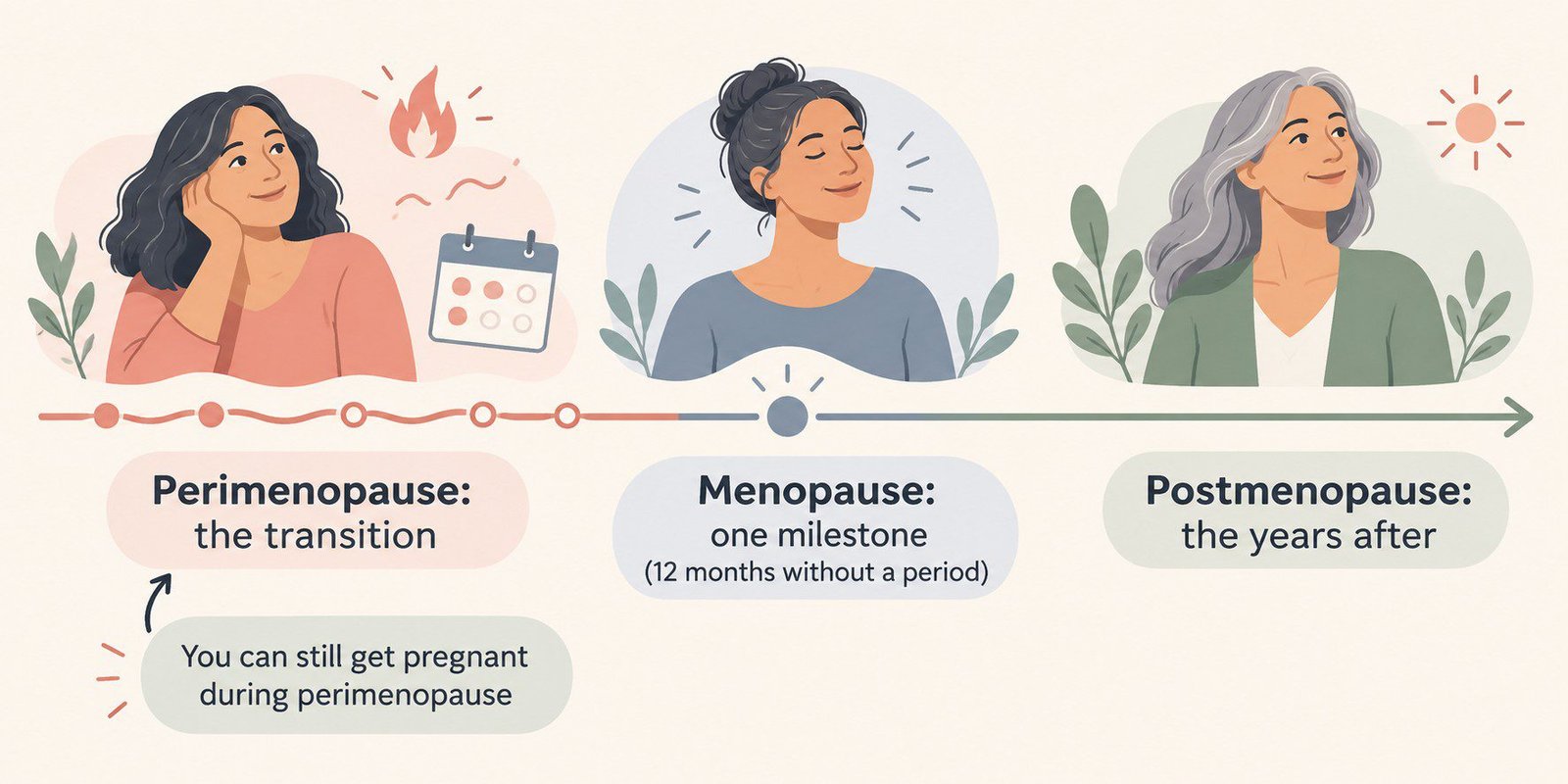
The confusion is understandable, because people use “menopause” to mean three different things. Here’s the simple version: perimenopause is the transition, menopause is a single milestone, and postmenopause is the time after it. Knowing the difference helps you describe what’s happening and get the right support.
Three stages at a glance
Scroll sideways to see all columns.
| Stage | What it means | Good to know |
|---|---|---|
| Perimenopause | The transition toward the end of your reproductive years | Periods and symptoms may change, and pregnancy is still possible |
| Menopause | Usually recognized after 12 months in a row without a period, when nothing else explains it | You only know you’ve reached it looking back |
| Postmenopause | The years after menopause | Some symptoms can continue for a while |
The Office on Women’s Health explains menopause and the transition. If you use hormonal birth control, have had certain procedures, or take medicines that affect bleeding, your periods may be harder to read, so the 12-month rule isn’t always straightforward.
What changes during perimenopause?
During perimenopause, your ovaries’ activity becomes less predictable, and reproductive hormones can rise and fall unevenly. Alongside that, many women notice:
- Changes in periods (shorter, longer, heavier, lighter, or skipped)
- Hot flashes and night sweats
- Trouble sleeping
- Mood changes
Experiences vary a lot. For one woman, the transition is disruptive; for another, it’s barely noticeable. The NIH menopause research overview describes this variation.
You may see charts with a smooth downward hormone line. That’s a simplified illustration, not a day-by-day picture of your body. One tough week doesn’t prove a particular hormone has dropped.
Do you need a blood test?
Often not. Your age, symptoms, and changes in your periods usually tell your doctor more than one hormone result. Levels of hormones like FSH and estradiol can swing during the transition, so testing helps only in specific situations. Read more in perimenopause hormone tests.
Two important safety notes
- You can still get pregnant during perimenopause, even with irregular periods. Talk to a healthcare professional about contraception rather than assuming you no longer need it.
- Bleeding after menopause needs to be checked. Don’t assume it’s your cycle returning.
The Office on Women’s Health describes both points.
What you can do: prepare for the conversation
Try keeping a short note with three headings:
Changes: What’s different from your usual pattern? Include bleeding, sleep, hot flashes, or anything else, without deciding the cause in advance.
Impact: What’s become harder? For example, “I’m awake several nights a week and struggling to concentrate at work” tells your doctor much more than a list of symptoms.
Questions: What else could explain this? Would a test help? What treatment options are there, and how will we follow up?
You don’t need to match someone else’s experience to ask for help. And a familiar-sounding symptom isn’t automatically menopause; your doctor can help sort that out.
Frequently asked questions
How long does perimenopause last?
It varies widely. For some women it’s a few years; for others it’s longer.
What age does perimenopause start?
Many women notice changes in their 40s, but timing differs from person to person.
Do symptoms stop after menopause?
Not always right away. Some symptoms, such as hot flashes, can continue into postmenopause.
For context on earlier years, read your menstrual cycle explained. The hormone glossary explains unfamiliar terms.