


You’ve probably heard estrogen and progesterone mentioned in the same breath, often alongside words like “imbalance” or “estrogen dominance.” Maybe you’ve even seen a chart claiming you need to fix your “ratio.” But what do these two hormones actually do?
In this article
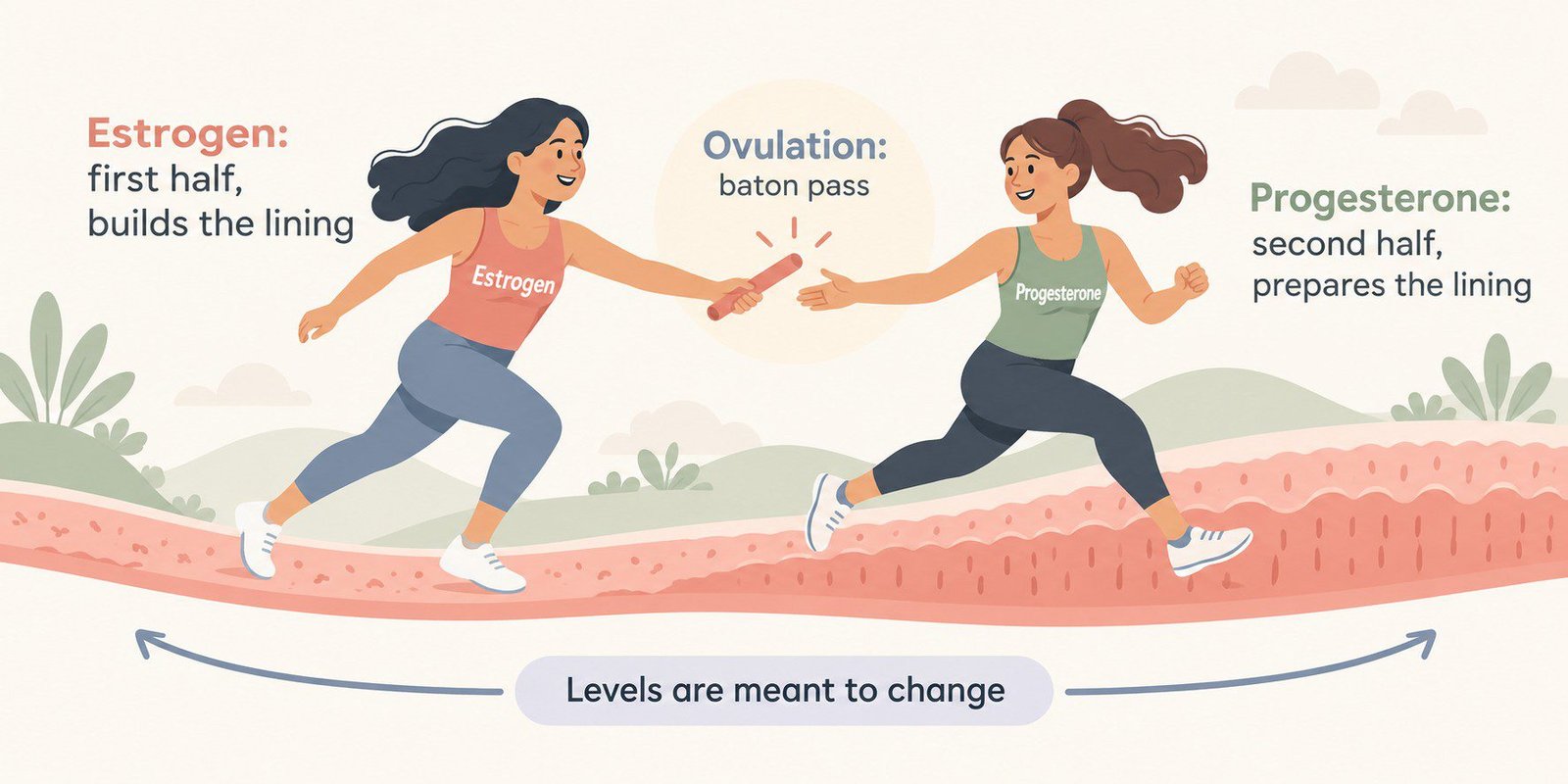
Think of them as a relay team. Estrogen runs the first leg of your cycle, helping build up the lining of your uterus. After ovulation, progesterone takes the baton, helping prepare that lining for a possible pregnancy. Their levels are meant to rise and fall. They’re not supposed to sit at one fixed “balanced” setting. The relay is a simplified comparison: estrogen still has a role after ovulation, too.
The difference at a glance
Scroll sideways to see all columns.
| Question | Estrogen | Progesterone |
|---|---|---|
| What is it? | A family of hormones, including estradiol | A single hormone in the progestogen family |
| When does it rise? | In the first half of the cycle, as a follicle develops | After ovulation |
| Main job in the uterus | Helps the lining build up | Helps prepare the lining for implantation |
| Can symptoms reveal its level? | No | No |
These are simplified patterns, not a guide to reading a blood test. The Society for Endocrinology explains how reproductive hormones interact during the cycle.
Estrogen: a family, not a single hormone
“Estrogen” can mean estradiol, estrone, or estriol. Estradiol is the main estrogen during your reproductive years (when you’re not pregnant), while estriol becomes more important during pregnancy. Estrogen also does a lot beyond reproduction, including helping keep your bones strong.
So if someone says “my estrogen is low,” it’s worth asking: which estrogen, why was it tested, and how was the result interpreted? MedlinePlus describes the main estrogen types and their tests.
Progesterone: the second-half hormone
After ovulation, the follicle that released the egg turns into a structure called the corpus luteum, which makes progesterone. If you don’t get pregnant, it stops working, progesterone drops, and your period starts. In early pregnancy, progesterone helps maintain the lining; later, the placenta takes over most of the production.
That’s why timing matters so much: a progesterone result before ovulation means something very different from one taken after. MedlinePlus explains progesterone testing and cycle timing.
Progesterone, progestin, progestogen: what’s the difference?
You’ll see these words on birth control and menopause medicine labels:
- Progestogen is the umbrella term.
- Progesterone is the hormone your body makes.
- Progestins are lab-made substances with similar effects.
Knowing the terms helps you read a label, but it doesn’t tell you which medicine is right for you. See the Society for Endocrinology’s progesterone explainer.
What you can do: four questions for any hormone claim
When a post says you need to fix your estrogen-to-progesterone ratio, ask:
- Is it describing normal biology, a measured result, or a diagnosed condition?
- Does it say when in the cycle the test was done, and which test?
- Is it honest about uncertainty, or using a symptom list to sell something?
- What evidence links the suggested fix to a result that actually matters?
If you’re feeling unwell, bring your concerns and any test results to a healthcare professional. A diagram can explain two hormones; it can’t explain why you feel the way you do.
Frequently asked questions
What is estrogen dominance?
It’s a popular online term, not a standard diagnosis. Symptoms often linked to it can have many causes and need proper assessment.
Can I tell if my progesterone is low from my symptoms?
No. Symptoms can’t reveal hormone levels, and progesterone tests must be timed to your cycle to be meaningful.
Why do estrogen and progesterone change during my cycle?
Because each has a job at a different stage. Changing levels are a normal part of how the cycle works.
For a wider view, read your menstrual cycle explained or look up terms in the hormone glossary.
Related reading
- FSH explained: the hormone behind follicle growth
- Hormone testing for women: what to ask first