


Maybe you were diagnosed with PCOS years ago and told it was “an ovary problem.” Or you were confused because your ultrasound didn’t show any cysts at all. Now you’re seeing a new name everywhere: PMOS. Is it a different condition? Do you need a new diagnosis?
In this article
The short answer: it’s the same condition with a more accurate name. Polycystic ovary syndrome (PCOS) is being renamed polyendocrine metabolic ovarian syndrome (PMOS). The goal is to describe what people actually experience, and to help more of them get diagnosed and supported.
What changed, and when?
The naming consensus was published online in The Lancet on May 12, 2026; the print issue followed in June. The published consensus report describes the international process.
Monash University reports that the initiative involved 56 patient and professional organizations, more than 22,000 survey responses across the wider naming effort, and international workshops. It describes a three-year transition and plans to incorporate the name in the 2028 international guideline update. These are implementation plans, rather than a date every clinic must change its records. Read Monash’s account of the name change.
Why the old name didn’t fit
“Polycystic” suggests the ovaries are full of cysts. In reality, what shows up on an ultrasound are small follicles, immature eggs that paused in their development. They aren’t true cysts. Monash describes findings of no increase in abnormal ovarian cysts in the condition. That does not mean a person with PCOS can never have an unrelated ovarian cyst.
The old name also put all the focus on the ovaries. But this condition can affect much more:
- Periods and ovulation
- Skin and hair, such as acne or extra hair growth
- Metabolism, including insulin resistance and type 2 diabetes risk
- Heart and cardiometabolic health
- Emotional wellbeing
As the consensus report explains, the new name is meant to reflect hormone involvement across several systems and the metabolic side of the condition, without presenting it as only a fertility issue.
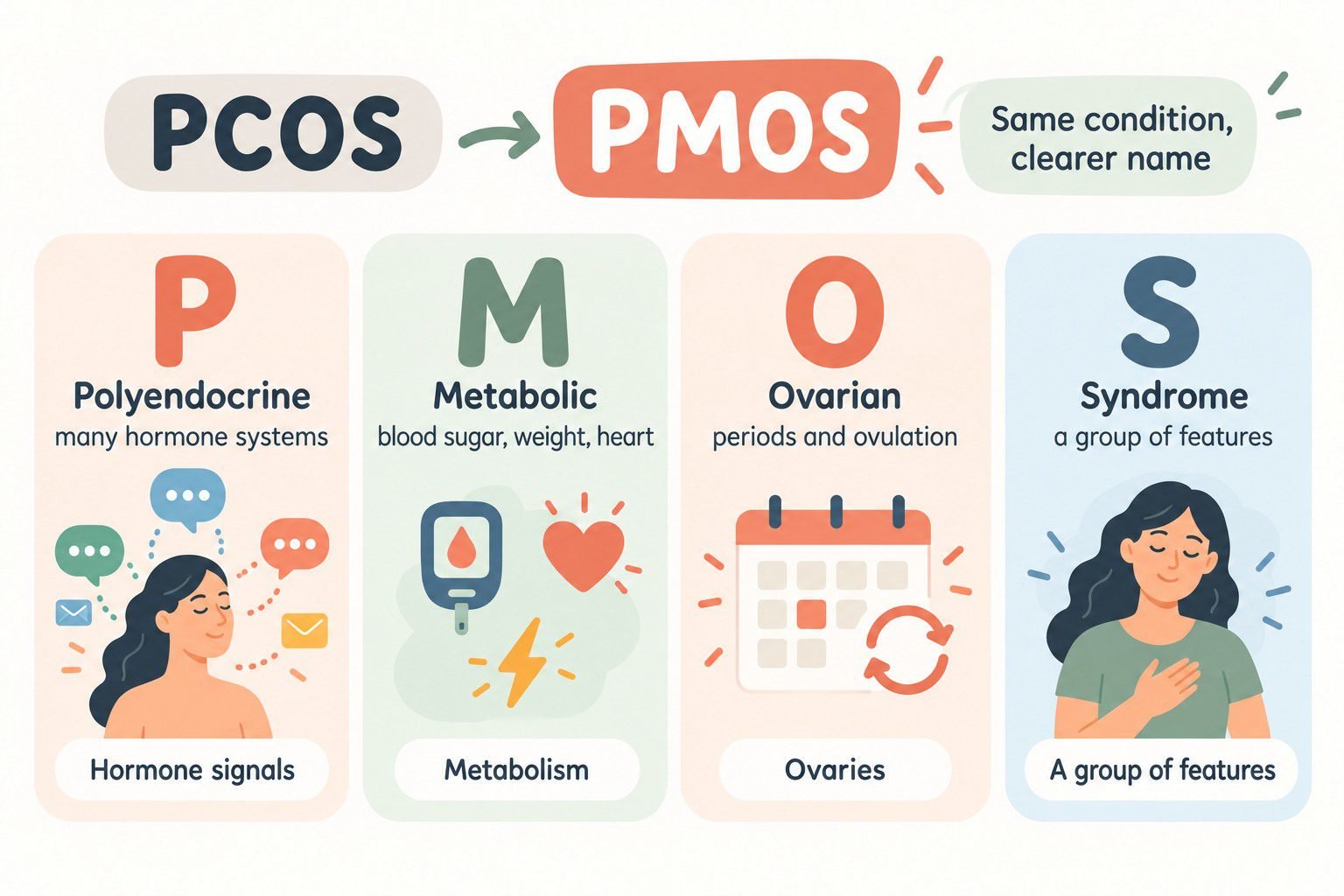
What the new name means, word by word
Scroll sideways to see all columns.
| Part of the name | What it points to |
|---|---|
| Polyendocrine | Several hormone systems are involved, not just the ovaries |
| Metabolic | Effects on blood sugar, insulin, weight, and heart health |
| Ovarian | The ovaries are still part of the picture, through ovulation and periods |
| Syndrome | A group of features that show up together, and not always in the same way |
What stays the same
This is a rename, not a new disease. The name change itself does not create a new diagnosis or require new tests. The international guideline recommendations, now presented under PMOS by ASRM, remain the reference for assessment and care. That means:
- Your diagnosis still stands. If you were diagnosed with PCOS, you have what’s now called PMOS.
- Diagnosis works the same way for now. Doctors still look at your periods and ovulation, signs of higher androgens, and ovary findings, and rule out other causes. Read PCOS explained for how that works, including the different rules for teens.
- Your treatment doesn’t change because of the name. Care still depends on your symptoms, your priorities, and your health history.
Medical records, guidelines, and disease classifications may take time to adopt the name. Keep your existing records and discuss any questions with your clinic rather than assuming a new acronym means a new treatment plan.
Why a name can make a real difference
It might seem like “just a name,” but names shape how a condition is understood. The WHO fact sheet estimates that up to 70% of affected women worldwide are undiagnosed. This is a global estimate, not a measure of your personal likelihood of having the condition. A name that highlights metabolism and hormones, not only cysts and fertility, may help:
- People without cysts, or who aren’t trying to get pregnant, recognize that the condition could apply to them
- Doctors look beyond periods to blood sugar, heart health, skin, and mood
- Care become more complete, with attention to long-term health
A new name alone won’t fix gaps in screening or access to care. But it’s a step toward taking the whole condition seriously.
What you can do now
- Don’t worry about re-diagnosis. You don’t need new tests just because the name changed.
- Use whichever name helps. If your clinic still uses PCOS, that’s okay. You can mention you’ve heard about PMOS.
- Ask about the “metabolic” part. If no one has checked your blood sugar, blood pressure, or cholesterol, ask whether that makes sense for you. Read about insulin resistance and prediabetes.
- Mention all your symptoms, including skin, hair, sleep, and mood, not only your periods.
- Look for support that fits you. Our guide to living with PCOS covers food, movement, supplements, and medical care.
Questions to ask your doctor
- Does the new name change anything about my diagnosis or care?
- Which parts of the condition should we keep an eye on for me: periods, skin, metabolism, mood?
- Is it time to check my metabolic health, like blood sugar and cholesterol?
- Will my medical records use PCOS or PMOS?
Frequently asked questions
Is PMOS a different condition from PCOS?
No. PMOS is the new name for the same condition. It’s meant to describe it more accurately.
Do I need to be re-diagnosed?
No. A PCOS diagnosis carries over. The diagnostic criteria haven’t changed with the name.
When will doctors start using PMOS?
Gradually. The name is being introduced over a three-year transition, and it’s expected in the international guideline planned for 2028. You may hear both names for a while.
Can I have PMOS without cysts?
Yes. In fact, the old name was changed partly because the ovary findings aren’t true cysts, and not everyone with the condition has them.