


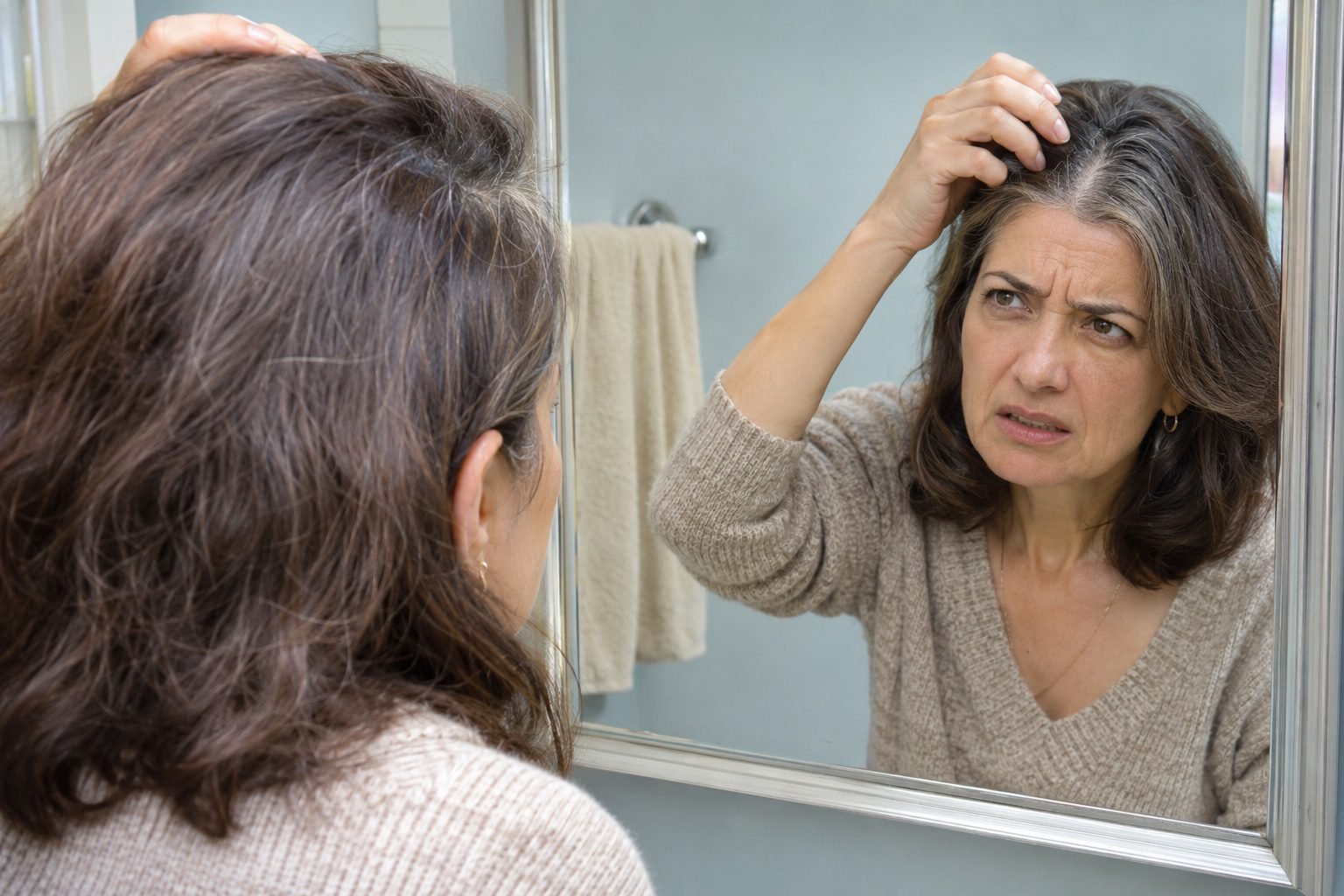
You catch your reflection under bright bathroom lights and wonder whether your part always looked that wide. Or you notice more loose hair than usual when you brush. Hair changes can feel unsettling, especially when you don’t know what is causing them.
In this article
The pattern and timing give a clinician useful clues. Hormones can be involved, but so can illness, medicines, hair care, nutrition, and inherited tendencies. Understanding the main possibilities helps you ask focused questions without having to diagnose yourself.
Extra shedding and gradual thinning
The American Academy of Dermatology (AAD) distinguishes excessive shedding from conditions that affect hair growth. More shedding can become noticeable a few months after childbirth, a high fever, illness, surgery, major stress, or stopping birth control pills.
Gradual thinning may show up as a widening part or less fullness. These descriptions can overlap: a person may have temporary shedding and an inherited hair-loss pattern at the same time. The AAD’s diagnosis guide explains why a scalp examination and health history matter.
Female pattern hair loss and midlife
Female pattern hair loss is inherited and often begins with a widening part. It is more common after menopause. That connection makes hormones relevant, but it does not mean every midlife hair change has the same cause.
MedlinePlus describes the cause as not fully understood, with possible contributions from aging, androgen changes, and family history. A visible part is not a measurement of androgen levels. Assessment also considers other causes, including thyroid disease and iron deficiency.
PCOS: scalp hair and body hair can change differently
The Office on Women’s Health lists thinning scalp hair, extra facial or body hair, acne, and irregular periods among possible PCOS symptoms. That can feel confusing: hair can become less full in one place while growing more in another.
Scalp thinning alone cannot diagnose PCOS. Tell your clinician about the full pattern, including any period or skin changes. Our PCOS guide explains assessment, and our PCOS/PMOS naming guide explains why you may see both names.
Shedding after pregnancy, illness, or stress
Temporary increased shedding is often called telogen effluvium. The AAD explains that it can start months after a trigger, rather than at the moment the change happens.
For example, someone might notice extra hair in the shower after recovering from a difficult illness and not connect the two events. Bring the timeline to your appointment; it is a clue, not proof of the cause.
For postpartum shedding, the AAD’s guidance for new mothers says shedding commonly peaks around four months after birth. Most regain their usual fullness by the child’s first birthday, sometimes earlier. If fullness has not returned after a year, a dermatologist can check for another cause. You can ask sooner if you are worried. See postpartum hormones for the wider transition.
Thyroid problems and other causes
The AAD’s overview of causes includes thyroid disease, certain nutrient deficiencies, medicines, tight hairstyles, damaging hair treatments, immune-related hair loss, and scalp conditions. The list is broader than reproductive hormones.
Let your clinician know about new symptoms elsewhere in your body, a recent illness, dietary restriction, medicines, or a change in hair care. Our thyroid test guide explains the lab terms if testing is recommended.
What you can do
- Bring a timeline. Note when you first noticed a change and what happened in the preceding months, including childbirth, illness, surgery, stress, or a medicine change.
- Describe the pattern. Mention shedding, changes in fullness, patches, or scalp discomfort. Photos in similar lighting can help you describe what you have noticed.
- Reduce avoidable pulling or damage. Tight styles and harsh treatments can contribute to hair loss. Ask about gentler options that fit your hair texture and routine.
- Review medicines before changing them. If you suspect a prescription is involved, speak with the prescriber; do not stop it on your own.
- Ask before buying hair supplements. The AAD advises checking for a relevant deficiency rather than assuming extra nutrients will help. Unnecessary supplements can cause harm.
When to talk to a doctor
Arrange an assessment if the change is sudden, patchy, keeps progressing, or concerns you. Tell the clinician about itching, scalp pain, redness, or scaling, and any changes in periods, facial hair, or acne. You do not need to wait six months before asking for help.
A dermatologist may examine your scalp and hair, review your history, and order a test or biopsy when there is a specific reason. A broad hormone panel is not automatically the first step; our hormone testing guide explains how tests answer different questions.
Treatment depends on the cause and your priorities. Some shedding settles as the body readjusts; other conditions need treatment to limit further loss. The AAD notes that early assessment can help with female pattern hair loss. Discuss pregnancy or breastfeeding when reviewing treatment options, since some medicines are unsuitable.
Frequently asked questions
Which hormone causes hair loss in women?
There is no single answer. Androgen-related conditions, thyroid disease, and changes after pregnancy can be relevant, while inherited hair loss and nonhormonal causes also need consideration.
Does a widening part mean my androgens are high?
No. The appearance alone cannot establish a hormone abnormality. A clinician considers your hair pattern, health history, and other signs before deciding whether testing would help.
Will my hair grow back?
It depends on the cause. Temporary shedding can improve, but recovery varies and several causes may coexist. An assessment is more useful than a fixed regrowth deadline.
Can stopping birth control trigger shedding?
Yes, the AAD lists stopping birth control pills as one possible trigger. Do not change contraception based on hair concerns alone; discuss your symptoms and options with your clinician.