


Your doctor ordered thyroid tests because you’ve been exhausted and always cold. The results arrive in your patient portal: TSH, free T4, maybe T3, each with a number and a range. One is flagged “high.” Does that mean your thyroid is overactive? Not necessarily, and this is where many people get confused.
TSH, T4, and T3 are related, but they measure different things. Once you understand how they talk to each other, your results become much easier to follow.
Three names, three roles
Scroll sideways to see all columns.
| Name | What it is | Its role in plain English |
|---|---|---|
| TSH | Thyroid-stimulating hormone, made by the pituitary gland | The message asking your thyroid to make hormones |
| T4 | Thyroxine | The main hormone your thyroid makes |
| T3 | Triiodothyronine | Another thyroid hormone, sometimes measured for specific questions |
Doctors often start with TSH and add other tests when needed. A T4 result can show the total amount or the “free” portion, which isn’t attached to carrier proteins. Pregnancy and some medicines change those proteins, so the difference matters. The NIDDK thyroid-testing guide explains how the tests are used.
The feedback loop: a thermostat in your body
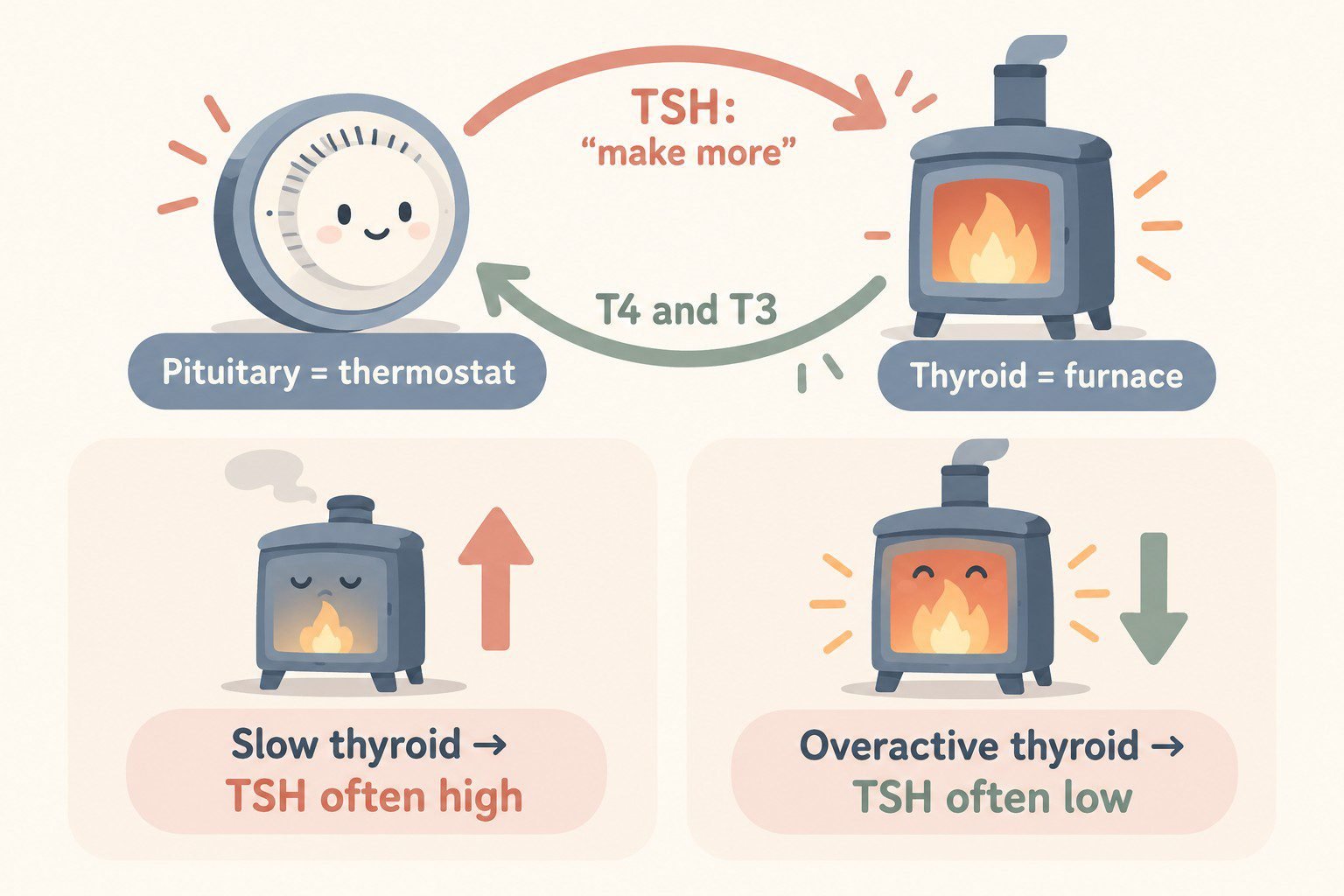
Think of your pituitary as a thermostat and your thyroid as the furnace. When the house is cold (not enough thyroid hormone), the thermostat calls louder for heat (more TSH). When it’s warm enough, the thermostat quiets down.
That’s why TSH and thyroid hormones often move in opposite directions.
Underactive thyroid (hypothyroidism)
When your thyroid doesn’t make enough hormone, your pituitary often responds with more TSH. So a high TSH can actually point to a slow thyroid. Possible symptoms include tiredness and feeling cold, but those are common and can’t confirm the diagnosis on their own. NIDDK describes underactive thyroid and how it’s evaluated.
Overactive thyroid (hyperthyroidism)
When your thyroid makes too much hormone, TSH often drops. Symptoms can include a racing heart, feeling too hot, and weight loss, but testing is needed to confirm it, and different causes need different evaluation. NIDDK’s hyperthyroidism guide explains this condition.
These are common patterns, not a complete list. Don’t use them to rule a condition in or out by yourself.
What you can do with your results
Before drawing conclusions, gather the details:
- Which tests are listed: TSH, free T4, total T4, T3, or others?
- What units and reference range does your lab show?
- Why was the test ordered?
- What symptoms or changes led to it?
- Which medicines or supplements do you take? (Tell your doctor about biotin, which can interfere with some lab tests; the NIH biotin fact sheet explains this risk.)
Compare your results only with your own lab’s ranges, not a screenshot from someone else’s report.
Questions to ask your doctor
- Are we looking at the signal (TSH), the thyroid’s output (T4/T3), or both?
- What does this result explain, and what doesn’t it explain?
- Do I need another test or a repeat?
- What’s the follow-up plan?
If you already take thyroid medicine, don’t start, stop, or change it based on an article. Your prescriber will guide any adjustments.
Frequently asked questions
Does high TSH mean hypothyroidism?
Often, a high TSH suggests the thyroid isn’t making enough hormone, but your doctor will look at T4 and your overall situation before diagnosing anything.
What’s the difference between T4 and free T4?
Total T4 includes both protein-bound and free hormone; free T4 measures the unattached portion. Pregnancy changes binding proteins, and thyroid results still need pregnancy-appropriate interpretation.
Can thyroid problems cause fatigue?
Yes, but so can many other things. Read fatigue and hormones to learn more.
Look up related terms in the hormone glossary or read about the pituitary gland.